How to find leads on social media without being spammy
Cold DMs and cold prospecting barely work. Here's a smarter way to find leads on social media: the people already asking for what you sell on Reddit, Hacker News and X.
 Paweł Z.Founder
For the longest time I thought getting customers meant convincing strangers. Cold DMs, launch posts, replying to anyone who vaguely fit. It felt gross, and it barely worked.
What changed things was small. I stopped trying to interrupt people and started finding the ones who were already asking. They were out there the whole time, describing my product in their own words, waiting for someone to point them at it.
This is the part nobody really tells you about distribution. You don't have to create demand out of nothing. On Reddit, Hacker News and X, people post their problems out loud every day. Your job is to be listening when they do, so you don't miss it, and to not be annoying when you show up.
Call it social selling, social media prospecting, or just paying attention. Whatever the label, the warmest leads are the people already describing your problem in their own words.
Here's how I go about it, after getting it wrong plenty of times.
Why don't cold DMs and launch posts work?
Because you're interrupting people who never asked, and every platform is built to punish exactly that. The instinct is to broadcast: write a launch post, drop your link in a few threads, DM a list of people who match your target customer.
It feels like work, so it feels productive. But the platforms are built to punish it. Reddit will shadowban you. Hacker News will flag you. On X you'll just get ignored.
The people worth reaching aren't waiting to be pitched. They're already talking. So the whole thing is listening, not broadcasting.
1. What should you actually search for?
Search for the problem in your customer's own words, not the name of your product. Most people do the opposite. If you sell software for practising sales calls, you search "sales training" or "cold call practice".
The trouble is your customers don't talk like that. They describe the pain, not the category.
Real buyers sound more like this:
- "my hands shake before every demo call"
- "is there anything that actually helps with pitch anxiety"
- "what do you all use for practising difficult conversations"
None of those contain your product's name. Search the frustration, not the category, and you surface a completely different, much warmer set of posts.
One way to start the list: go back through every conversation you've had with a customer and write down how they described the problem, in their exact words. It sounds quick. It isn't. You'll be digging through old DMs, call notes and reviews, second-guessing the phrasing as you go. But those messy, real sentences are the search queries that actually work.
2. How do you tell a real buyer from noise?
Read each post for intent, not the keywords it happens to contain. Once you search by phrasing, you'll get more matches than you expect, and most of them still won't be buyers.
The same words turn up in jokes, in self-promotion, and in posts that mean the opposite of what they say. "Oh yeah, cold calling is so fun" is not a lead. Sarcasm alone breaks any pure keyword approach.
So before you reply, ask one thing about each post: does this person actually have the problem I solve, right now?
- Someone venting about a real, current frustration is worth a reply.
- Someone idly musing, arguing theory, or promoting their own thing is not.
Intent is the filter that turns a noisy list into a short list of people genuinely worth your time. It's slower than skimming for keywords, but it's the difference between being helpful and being noise.
3. How do you reply without getting banned?
Reply like a regular of the platform, not a marketer. Be useful first, and bring up your product only if it genuinely fits. This is where most founders get banned, and it's also the easiest part to get right: behave like a normal user, because each platform has its own rules.
- Hacker News: technical and skeptical. Lead with something genuinely useful, drop the marketing language, and usually skip the link unless someone asks. Show you know the topic.
- Reddit: casual and community-first. Read the subreddit's rules, give a real answer first, and mention your product only if it truly fits, with a clear note that it's yours.
- X: short and human. A useful one-liner beats a paragraph. Replies that read like an ad get scrolled straight past.
The rule is the same everywhere: be useful first, and honest about what you make. People are surprisingly forgiving of "I built a thing for exactly this" when the reply helped on its own. They turn the moment it reads like an ad.
A simple test: if your comment would still be worth posting with the link removed, you're doing it right.
4. How do you reach people while it still matters?
Reply while the post is still fresh, because speed matters more than it should. The first helpful reply on a fresh post gets seen. The tenth, posted two days later, doesn't. Most of these conversations have a short window where a reply is still welcome.
The bar for beating everyone else is lower than you'd think. A landmark HBR study that audited 2,241 companies found the average first response to a lead took 42 hours, and 23% never replied at all. People expect the opposite: in the 2025 Sprout Social Index, 73% said they expect a brand to respond on social within a day. Slow is the norm, so just showing up early and genuinely helpful is a bigger edge than it should be.
The catch is that watching Reddit, Hacker News and X all day, for the right phrasing, is its own full-time job. Nobody keeps it up by hand for long. I tried, and mostly I just lost evenings to scrolling and second-guessing which posts were worth a reply. It doesn't scale on willpower alone.
So I built the thing I kept wishing existed
The whole method comes down to four moves:
- Search for the problem in your customers' words, not your product's name.
- Read each post for real intent, not matching keywords.
- Reply like a regular of the platform, useful first and link last.
- Get there while the post is still fresh.
The trouble is the last move. Listening doesn't fit inside a human day. Buyers post on their schedule, not yours, and the window closes fast. By hand, you're either glued to a dozen feeds or missing the ones that mattered. That was the wall I kept hitting.
So I built Leads Run to take that part off your plate. Leads Run is a tool that watches seven platforms for buyer-intent posts: Reddit, Hacker News, X, Product Hunt, Indie Hackers, Lobsters and Bluesky. It reads each post for intent rather than keywords, labels it cold, warm or hot, and suggests a reply in about 30 seconds. You paste your link, it learns the phrasing your buyers actually use, and it does the listening for you around the clock. When a high-intent post shows up, it pings you instead of making you check, so you can reply while the thread is still fresh rather than living in the feeds.
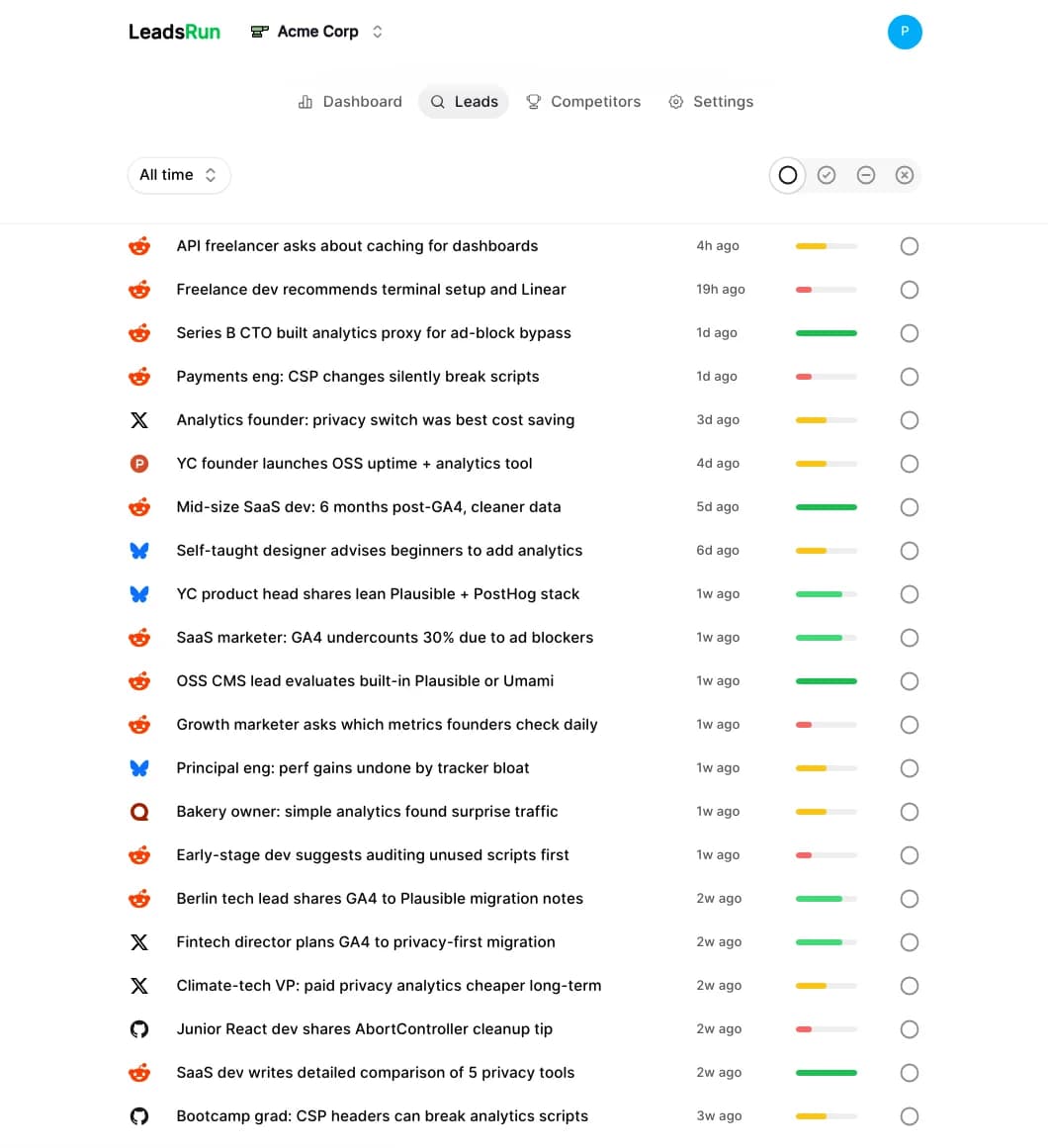
What's left for you is the only part that was ever the point: replying to a warm lead, someone who's already asking, while the conversation is still fresh. The searching, the filtering, the not-missing-it, that part is handled.
The method is free and it works with nothing but a search bar and some patience. But if the listening is the thing that's been quietly defeating you, that's exactly the part I can take off your hands.
Your next customer is posting right now.
Paste a link to your product. We'll find the people who need it.
Limited spots · 120 already joined